Connoisseur's Guide
The Sixty-Second Test: How to Recognize a True Hand-Knotted Rug
2026-07-27
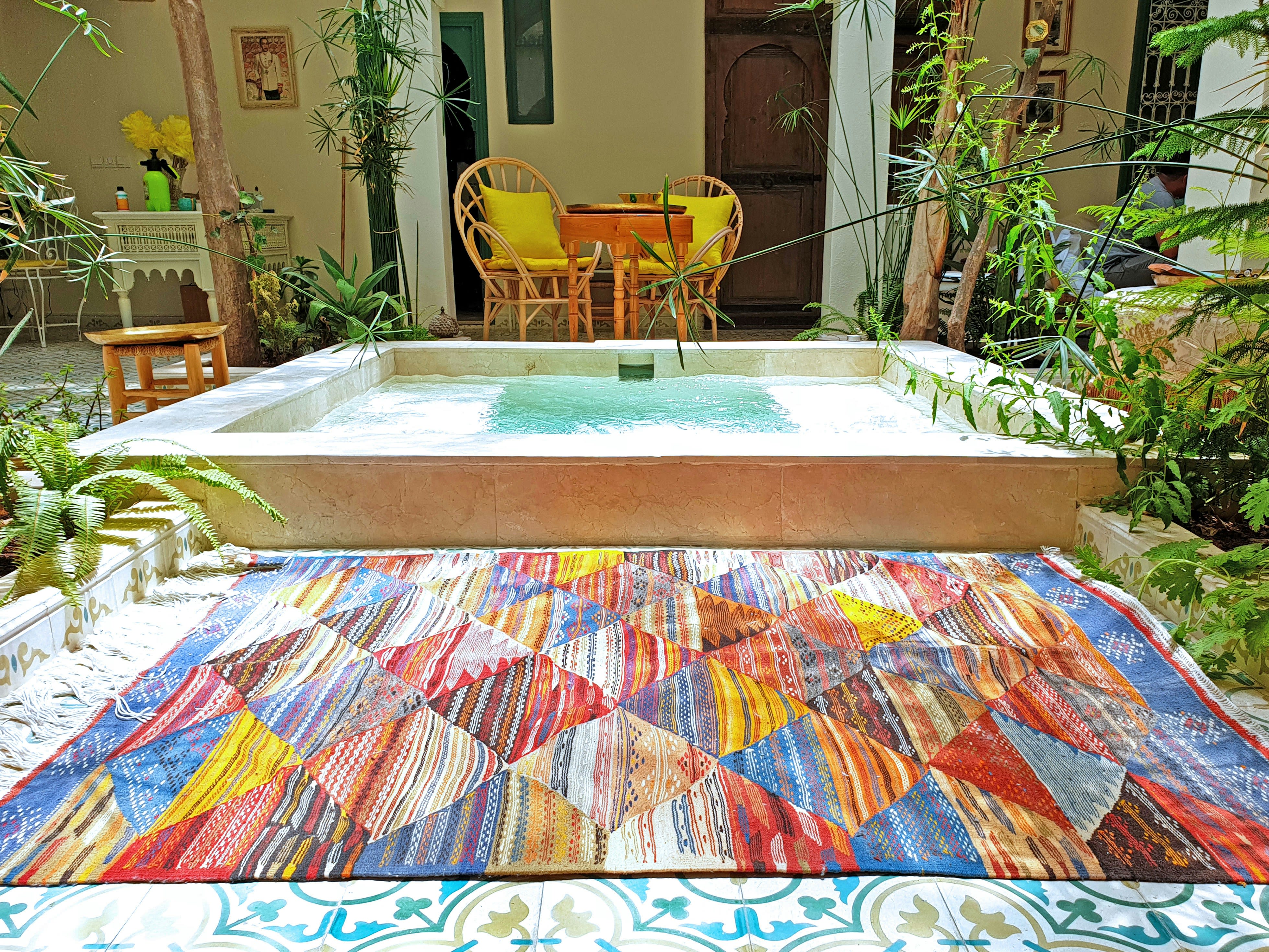
We make hand-knotted rugs for a living, and it troubles us how often machine-made pieces borrow the name. You do not need to be an expert to tell the difference. You need one minute, and you need to know where to look.
The Quiet Problem with Rug Labels
The words "hand-knotted" appear on far more rugs than hands ever touched. Sometimes it is careless labeling; sometimes it is a calculated borrowing of prestige, because those two words carry months of an artisan's life within them. And from the front, the borrowing works — a well-made machine rug can flatter the eye of almost anyone. This is precisely why none of the checks that follow begin at the front of a rug. The truth of a rug, like the truth of most fine things, lives in the parts you are not shown first.
Begin with the Back — It Never Lies
Turn the rug over. A true hand-knotted piece reveals its pattern on the reverse almost as clearly as on the face, because the design is not applied to the rug; it is the rug, built from thousands of knots that pass entirely through the foundation. Examined closely, the reverse carries a gentle irregularity, each knot a breath different from its neighbor. A machine-made rug tells another story: a flawless grid, rows of mechanical stitching, or a stiff synthetic mesh. And if a seller hesitates to show you the back, consider that its own answer.
Read the Fringe
On a hand-knotted rug, the fringe is not a decorative afterthought. Those threads are the warp — the skeleton upon which every knot was tied — and they emerge from the body of the rug as naturally as branches from a trunk. They cannot be separated from the piece without unmaking it. Machine-made rugs imitate the look by sewing or gluing a fringe on afterward. Study the point where fringe meets rug: a visible line of stitching attaching it is one of the fastest confessions a rug can make.
Fold a Corner
Fold a corner of the rug gently back on itself, pile outward. A hand-knotted rug yields easily, and at the base of the pile you can see the knots themselves, gripping the foundation in softly uneven rows. A stiff fold, or an underside concealed beneath a bonded fabric backing, tells you that adhesive is doing the work knots should be doing. Glue has its place in rug making — but not in a rug presented as hand-knotted.
Look for the Human Signature
Here is the connoisseur's secret, and it feels backwards at first: perfection is the machine's tell. A rug made by hand across many months carries small human signatures. A motif that differs by a few millimeters from its twin across the field. The subtle drift of color where one dye lot gave way to the next — the trade calls it abrash, and collectors prize it. Rows that breathe rather than run laser-straight. A machine repeats its pattern with mechanical exactness; an artisan never does. In handmade work, these variations are not flaws. They are the signature.
Trust Your Nose
Fold the rug and bring your nose close to the base of the pile on the underside. A hand-knotted rug smells of wool — faintly rich with lanolin, sometimes carrying a trace of its final wash. What it never smells of is glue. A latex or chemical note means adhesive is holding the construction together, which points to a bonded backing rather than knots. New synthetics announce themselves as well, with a plastic edge that wool simply does not possess. The nose catches in two seconds what the eye can miss for years.
A Word of Respect for Hand-Tufted Rugs
A distinction worth making. The hand-tufted rug — where artisans draw yarn through a foundation cloth with a tufting tool — is genuine handwork, and an honorable craft in its own right. We make them, and for many interiors they are precisely the right choice. The concern of this guide is not the hand-tufted rug. It is the tufted or machine-made rug dressed in a hand-knotted label. Each construction has its own character and its own kind of making, and you deserve the one written on the tag.
Why the Label Slips Through
Because almost no one turns the rug over. Rugs are judged the way paintings are — from the front, at a polite distance — while everything that matters is happening at the back, the fringe, and the base of the pile. Much of the market quietly depends on that habit. You now know better, and it took only a minute.
Ask to See the Back
At Nafya Rugs we photograph the backs of our rugs unprompted, because the back is the proof. Our hand-knotted pieces leave the looms of Bhadohi with their knot count, material, and construction exactly as described. Whoever you buy from, ask for photographs of the back and the fringe. A maker with nothing to hide will send them within the hour — and will usually be pleased that you asked.
Frequently Asked Questions
What is the fastest way to tell if a rug is really hand-knotted?
Flip it over. On a genuine hand-knotted rug the pattern is clearly visible on the back because each knot goes through the foundation. Machine-made rugs show a uniform grid, stitching rows, or a mesh backing instead.
Do fake hand-knotted rugs have fringe?
Often, yes, but it is sewn or glued on afterward. On a real hand-knotted rug the fringe is the warp threads the rug was woven on, so it grows out of the rug body with no stitch line attaching it.
Is a hand-tufted rug a fake hand-knotted rug?
No. Hand-tufted is a legitimate handmade construction and a good product when sold honestly. It only becomes a problem when tufted or machine-made rugs are labeled and sold as hand-knotted.
How long does it take to make a real hand-knotted rug?
A skilled weaver ties several thousand knots in a day, and an 8x10 rug holds over a million knots, so a genuine hand-knotted rug represents months of work before dyeing, washing, and finishing are even counted.
Can I ask a seller for photos of the back of a rug?
You should, every time. Honest makers, including Nafya Rugs, will happily share photos of the back, the fringe, and the base of the pile, because that is where genuine construction shows.
Looking for Custom Handmade Rugs?
Nafya Rugs works with designers, retailers, and project buyers to create handmade rugs tailored by size, material, color, and design.
Start an Inquiry